
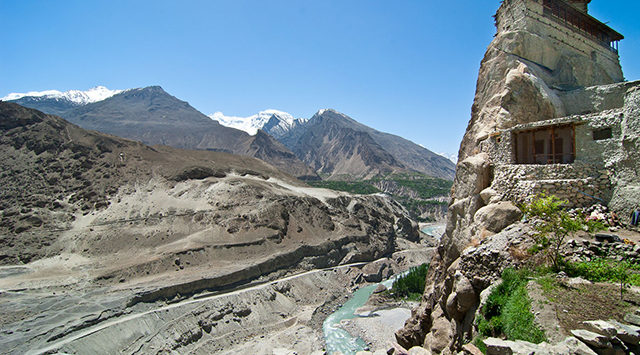


If you’re looking to take a cultural side trip from the urban milieu and want a breathtaking adventure to write home about, visiting Altit Fort in Pakistan is a must-see opportunity. Altit, meaning “this side down”, stands eternal watch over the Hunza mountain range, a jagged peaked series of snow-crested mountains in north eastern Pakistan. Situated at the convergence of the Hunza and Nagar valleys, the fort was used as a strategic choke point for reconnaissance and defense, and helped the ruling Mir family defend invasions from China and the Kievan Rus. Surviving the test of time against earthquakes, sieges, and foreign occupiers the solitary outpost was built 1100 years ago as a palace for the royal Mirs and now serves as an attractive meeting place for anyone to meet convivial locals in a scenic location.
Before climbing up to the ancient sentinel, you’ll be greeted by the happy residents of Altit, a quaint village nestled in the Hunza valley flanked with sloping terraces. Children and parents welcome you with warm smiles and interest as they splash each other in bathing pools. The nearby city of Karimabad, which is roughly fifteen minutes away by car, pipelines pure mineral water to the village from the UltarSar Glacier. This fortunate infrastructure allows for safe drinking water to residents and tourists all over the region of Gilgit Baltistan.

As you meander through the rustic dwellings, you’ll probably witness a concert of men playing the hareep or local music. Holding flutes, drums, and Sitaars locals sometimes play and dance to folk songs such as the Nazimkahani Dani, a dancing tune for tribute to the Mir Nazim Khan, ruler of Hunza in the early 20th century. According to local legend, these inhabitants of the Burusho tribe are blood descendants from the left-over Greek forces of Alexander the Great. They also claim ancestry from Hunnic tribes in Persia and central Asia around the mid 1st century AD. For a modicum fee of two dollars, English-speaking guides from the town will offer you gems of insight into the fort’s history as you are escorted up to the towering structure, 1,000 feet above the Hunza river.

At the top of the Shikari tower, “hunter’s tower” you’ll get a spectacular view of the fort’s panoramic vision and it’s ideal location as a defensive beacon. Singing and music from Altit’s endless festivities play along in timeless gaiety as you gaze three hundred degrees around the picturesque backdrop of Gilgit Baltistan’s treacherous mountain range. With this jaw-dropping view, visitors can take stunning pictures of glacier-tipped peaks such as Lady Finger, Ultar, Rakaposhi and Shishpar.
Across the other bank of the river, you can spot the great Silk Road; where countless trade caravans and conquerors had once hoarded over the wealthy land route, connecting Medieval Europe to Asian civilization. Running parallel with the blue Hunza, the ancient Karakorum highway stretches along this segment of the silk road – once serving as one of the chief routes for travel between the Mongolian Khanates.
Taking advantage of the unforgiving terrain, the fort ensconces itself on a rocky promontory overlooking the mountainous river. With its sheer escarpment, invaders would be easily intimidated facing a natural defensive fortification. According to ancient village lore, the fort was constructed at the honorable request of an architect from Baltistan which was ruled by princess Ayashu, then married to Shah Khan, Mir of Hunza. Before arriving at the main entrance of this sturdy construction, you’ll come across a workshop, where the women of the village hand craft and sell intricately carved wooden goods.
Adjacent to this creative craft house is a garden interlaced with juts of mountain grass, conifer trees, and pines. Feel free to rest in the cool shade of the lush grove and enjoy the solitude of this natural blessing before venturing to the stalwart fortress. The lush garden is also dotted with apricot trees, offering ripe and sweet fruits that will revitalize your senses up the elevated terrain. You may see locals drying the apricots on their square-roofed huts in the sun; preserving the multi-purpose fruit for food dehydration.

When you reach Altit fort’s front entrance way, you’ll see a pair of five feet tall iron doors barring would-be attackers. This cleverly gated door deters intruders who would have to bend low to breach through the entrance and risk being cut down by defenders in the antechamber. This Tibetan-like architectural marvel has three levels. Its floors are composed of stone for storing food and raw materials while the perimeter walls are made up of hard-packed clay and wood.
Inside the remarkably kept main chamber, local guides will inform you of its place of divine worship and social activity, and you’ll see a elegantly handcrafted wooden chest – used as a granary for wheat. Also placed in this ancient kitchen and living room are the culinary tools used by the Mir royal family, including pots, bowls, and tin kettles as well as holes in the rock for cooking fires.
Twisting through its mysterious skinny passageways and portals, your guide might point out other holes with wooden lids placed over them. These gloomy crevices are the fort’s dungeons, where prisoners were held in captivity. Adding to their solitary torment, the captives were at the mercy of the royal family’s insidious torture methods, such as urinating and defecating on top of them. If the crime was serious, royal guardsmen would throw the helpless prisoners off the high shikari tower into the perilous stream below.

On the second level is a convex lantern-shaped roof with four corner columns, connecting the stone floor to the ceiling. The elemental symbolism of this architecture reflects the fort’s divine purpose as a “pillar of the world.” Interestingly, many homes throughout the village contain these cosmic pillars, as if they are obligated to hold the entire earth together on its axis at Altit’s critical geographical juncture.
On your way back down through Altit village, don’t forget to stop by at a quaint bakery called the Cafe de Hunza. The restaurant is well-established and offers home made sweet cakes and coffee at generous prices. Traveling back to your accommodation in Karimabad can be easily traversed by walking and takes approximately 30 minutes.
You’ll have a quite a story to share if you go to Altit, and exploring this gem of archaic beauty in central Asia is one of those rare and unique adventures you’ll never forget.

